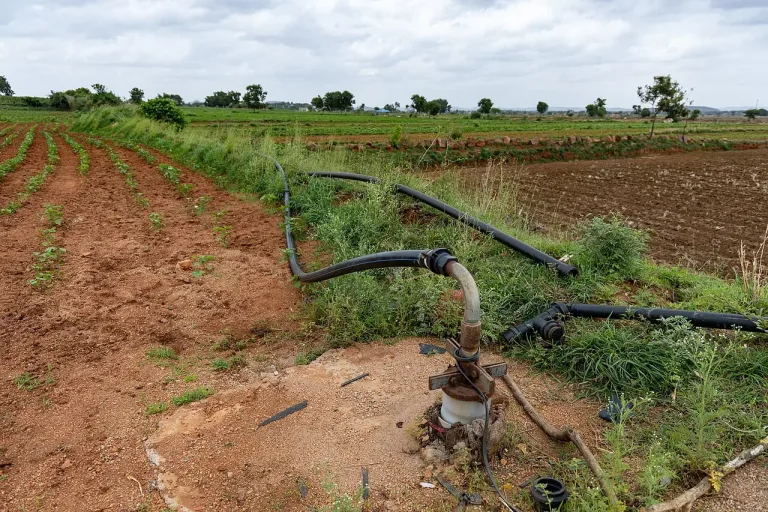
Borewell depth is not the same as pump head
A borewell may be 100 m deep without the pump needing a 100 m static lift. The water level while pumping and the delivery point matter. Bore depth, pump setting depth and pumping water level describe different things. Write each one separately when discussing a pump.
This guide explains the information needed for a selection discussion. It does not recommend an HP rating, pump model or installation depth.
Keep these measurements separate
| Measurement | What to record |
|---|---|
| Total bore depth | The depth of the drilled bore. |
| Pump setting depth | The depth at which the pump is installed. |
| Resting water level | The water level with the pump stopped, with the measurement conditions noted. |
| Pumping water level | The water level at a stated pumping flow after the level has settled. |
| Delivery point | The destination elevation and any required pressure. |
Use one reference, such as the borewell head, for the depth and height measurements. Otherwise two figures can appear comparable while using different starting points.
Understand the head requirement
Head expresses energy per unit weight of liquid and is commonly stated in metres. A system assessment accounts for the elevation difference, required pressure and flow-related losses. Pipe length, diameter, fittings and flow affect the loss calculation.
For a simplified open-tank example, with negligible velocity-head difference and no extra outlet-pressure requirement, the planning total is the lift from the pumping water level to the receiving water level plus the assessed losses. This simplified example does not cover every installation.
A worked example with stated assumptions
The following values are invented for explanation, not a product rating:
| Input | Illustrative value |
|---|---|
| Total bore depth | 100 m below the reference |
| Pump setting depth | 60 m below the reference |
| Pumping water level | 35 m below the reference |
| Receiving water level | 10 m above the reference |
| Assessed losses at the required flow | 8 m |
| Additional pressure head | 0 m |
The static lift is 35 + 10 = 45 m. Under these assumptions, the planning total is 45 + 8 = 53 m. The 8 m loss is an assumed input; it has not been calculated from an actual pipe system. The pipe route from the installed pump still matters when assessing those losses.
Specify flow together with head
Flow is the quantity of water required per unit time. Keep its unit visible. For example, 2 m³/h = 2,000 litres per hour ≈ 33.3 litres per minute. This is a unit conversion, not a recommended output.
A head figure alone leaves the desired water quantity unanswered. Ask the supplier to show the required flow and head together on the proposed model’s H/Q curve. A curve presents paired operating values; selecting unrelated headline figures does not establish the required duty point.
What to ask the supplier
- Which measured pumping water level and flow were used?
- How were pipe and fitting losses assessed?
- Does the proposed curve cover the required duty within the manufacturer’s permitted operating range?
- What happens if the pumping water level changes?
- Which motor and matched starter are proposed for the available supply?
Keep the measurements, assumptions and curve reference with the quotation. When a measurement is missing, mark it as unknown rather than replacing it with the bore’s total depth.